Most offices worry about conversations being overheard. In a post-production facility the exposure is different and considerably more serious: unreleased material visible through a glass wall to anyone walking a corridor. That's not an etiquette problem, it's a contractual one, and it has a straightforward physical fix.
The exposure is a sightline
Walk a typical creative floor plate and count what's visible from the circulation route. Monitors displaying works in progress, reference walls with unreleased artwork, whiteboards with schedules and titles, and review rooms with a screen facing the door.
Now consider who walks that route: vendors, freelancers on short engagements, delivery staff, building maintenance, and visitors. Confidentiality obligations in this industry are contractual and audited, and "nobody would really look" is not a position anyone wants to defend after the fact.
Why not just build walls
Sometimes that is the answer, and where a room is genuinely high-sensitivity it usually is. But glass partitions exist for a reason. They let daylight reach the interior of a deep floor plate that would otherwise be entirely artificially lit, and they keep a creative space feeling connected rather than a corridor of closed doors.
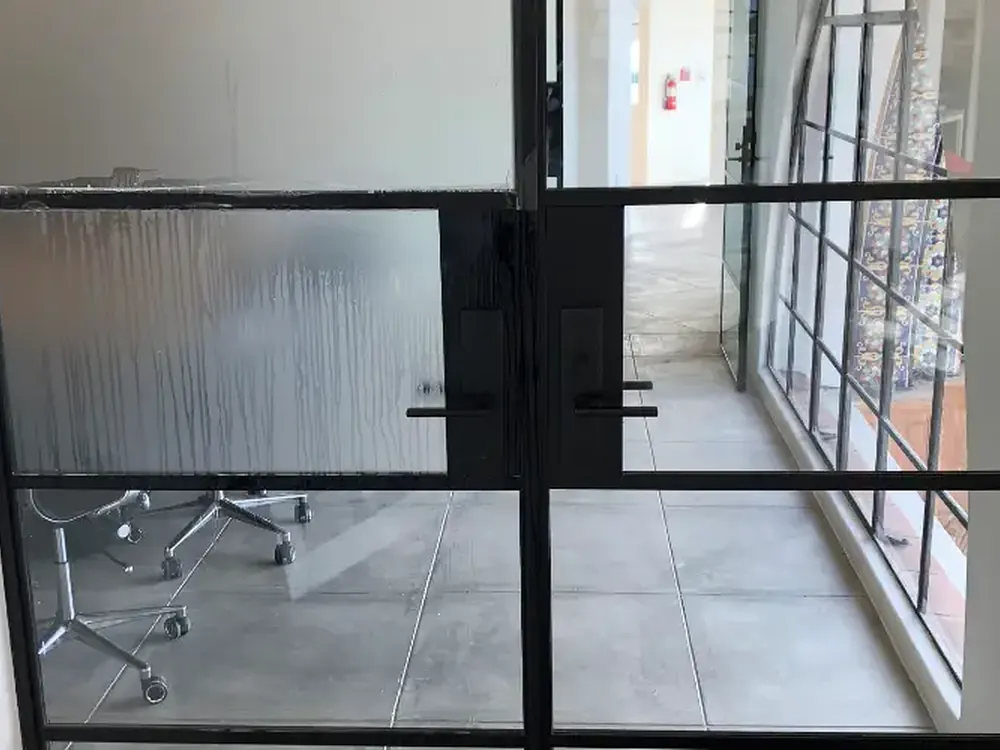
Frosted film keeps both. It's a matte polyester laminate that scatters light rather than blocking it, reading as sandblasted or acid-etched glass while still passing daylight through. You lose the sightline, not the light — which is precisely the trade you want. That's what frosted privacy film does, at a fraction of the cost of replacing the partition.

Coverage should vary by room
Applying one treatment across a whole floor is the common mistake. Match it to what the room does:
- Full frost — total visual privacy. The correct choice for review rooms, edit bays, and anywhere content is displayed.
- Banding at seated eye level — right for general meeting rooms where the concern is conversation rather than content.
- Gradient — frost fading from opaque at the base to clear at the top, where partial screening is enough.
- Cut graphics — logos and patterns from frost film, for branding plus incidental screening in circulation areas.
Over-frosting general meeting rooms costs daylight across the floor plate for no security benefit, and it's the change most likely to make a space feel worse to work in.
Don't forget the exterior sightline
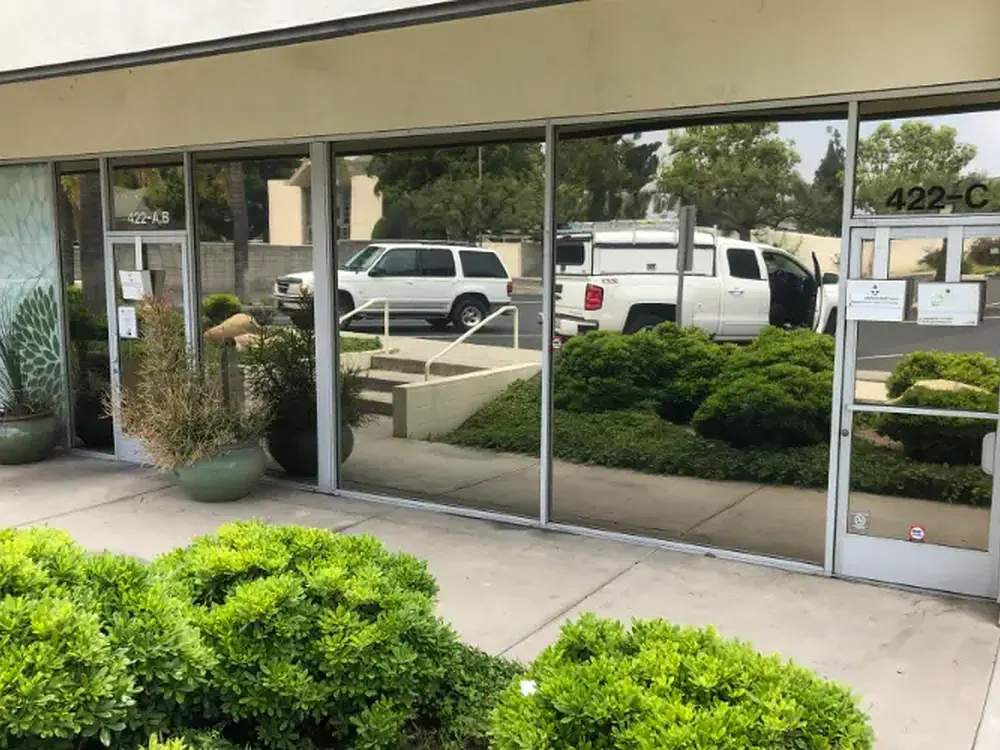
The internal corridor gets all the attention and the outside frequently doesn't. Ground-floor and first-floor rooms with exterior glazing can be visible from a sidewalk, a neighbouring building, or a parking structure — sometimes from a considerable distance with an ordinary phone camera.
Perimeter glass in a sensitive room needs treating too, and there the choice is different: a frost handles it, but so does a dual-reflective solar film that provides daytime privacy while preserving the outward view. Which is right depends on whether people need to see out. It's worth walking the exterior of your own building and looking in.
It comes off between projects
Production spaces reconfigure constantly. A suite set up for one project becomes something else six months later, and the room that needed full coverage may not need it next time. Etched glass is a permanent commitment; film comes off cleanly and goes back on in the new configuration.
The same applies at lease end, when the landlord generally wants clear glass back. If you're planning a fit-out or fixing one that isn't working, send us the floor plan and we'll mark up what each room actually needs.